France-first scouting 3 min read
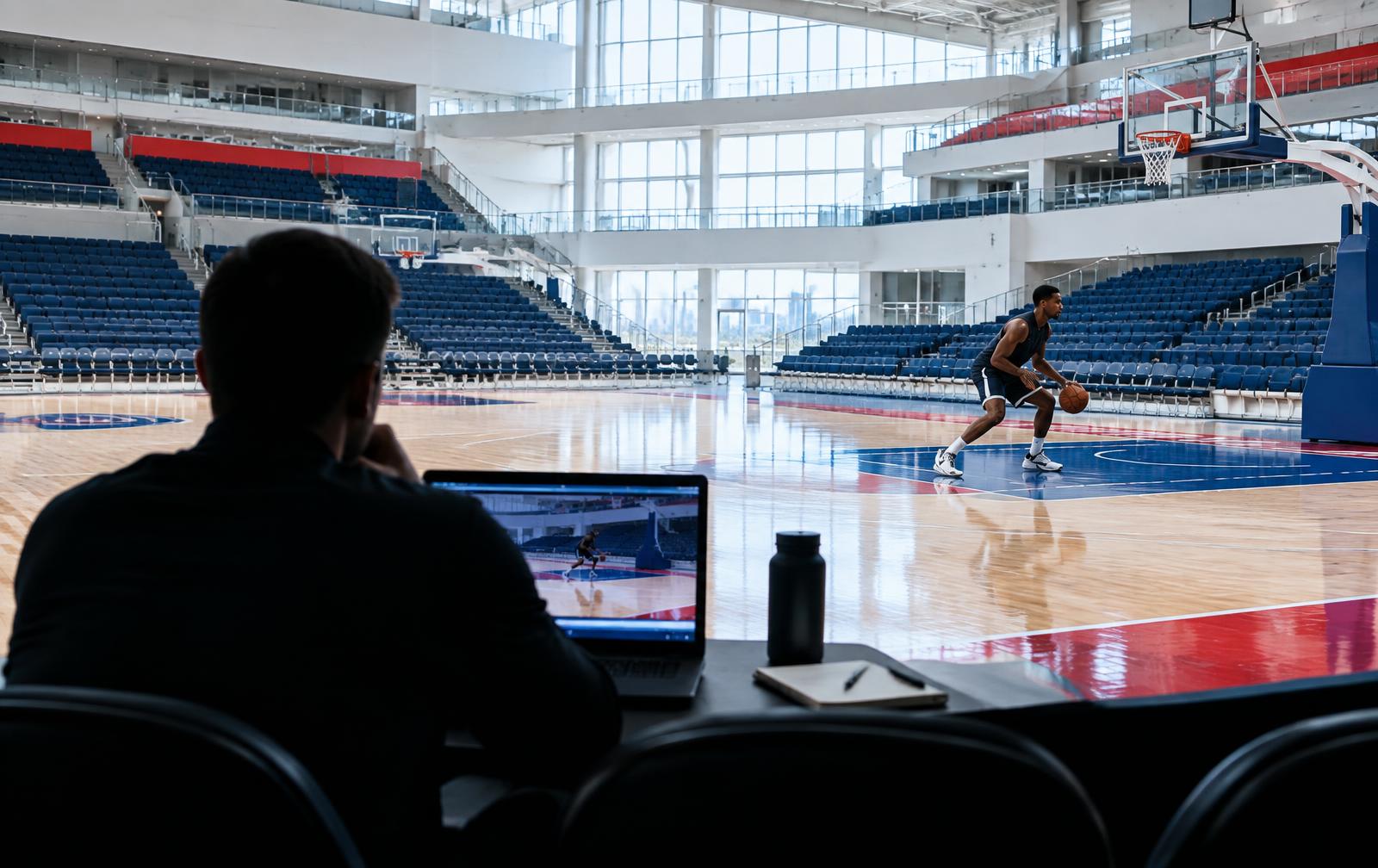
Evaluating French basketball prospects across competitions.
French prospect evaluation is strongest when it follows the same player across changing environments. A domestic youth game, an ANGT event and a national-team tournament can reveal different aspects of the same profile. The challenge is to compare those observations without treating every competition or role as equivalent.
Scouting Lab editorial / About the service
01 / Field notes
Map the environments before comparing the players
Begin by identifying where each observation comes from: domestic club competition, a youth event, an academy team or international basketball. Check the age group, season and the team's roster. Competition names alone do not explain the quality of a matchup or the responsibilities a player carries.
Use official competition and federation information to verify dates and rosters. ANGT provides an additional setting for evaluating young prospects, but a tournament appearance is not by itself a guarantee of professional or college success. Treat each event as another piece of the evidence rather than a final verdict.
02 / Field notes
Compare role changes rather than raw production
A player who creates most of a club team's offense may be an off-ball contributor with a national team. Lower scoring in that setting can reflect a different assignment rather than a decline. Watch whether the player's spacing, decision speed and defensive engagement remain useful when fewer possessions run through them.
Conversely, a strong tournament scoring total should be examined for its source. Transition opportunities, offensive rebounds and difficult late-clock attempts do not all translate in the same way. Look for skills that survive a smaller role, stronger defenders or less space.
03 / Field notes
Account for age and physical development
Chronological age, physical development and basketball experience should not be collapsed into a single label. A player with a present strength advantage may dominate younger opponents without showing a transferable skill package. A less physically developed player may already make high-level reads while struggling to finish through contact.
Keep the evaluation specific. Track balance, coordination, repeat effort and movement quality, then revisit the profile when the environment changes. Do not infer a medical condition, predict adult measurements or promise a future athletic leap from video alone.
04 / Field notes
Build a multi-season observation trail
Organize film by season and competition. For each review, note the player's role, the opponent, the strongest repeatable action and the biggest open question. This makes it easier to distinguish real development from a favorable matchup or a temporary shooting run.
A meaningful follow-up asks whether the same issue has changed. Is the player reading the second defender earlier? Can they defend the same action without giving up an advantage? Are they contributing when the ball is elsewhere? Consistent questions make a longitudinal report more useful than unrelated game summaries.
- Confirm season and age group for every film sample.
- Compare club and international roles separately.
- Track decisions and off-ball contributions as well as production.
- Preserve earlier notes to identify development or recurring limitations.
05 / Field notes
Connect the report with the relevant archive
Use Scouting Lab's player directory to identify the available dossiers, then move to the video library for competition and player film. The NCAA rankings offer a separate view of the college landscape; they should be read in the context of the edition, season and available data rather than as a universal talent hierarchy.
For an individual prospect, start with the published dossier and its available context. Do not assume that every player has a complete statistical record or a fully documented multi-season archive. Where evidence is missing, the correct next step is further observation, not a stronger claim.
Common questions
Does success in a youth tournament predict NBA success?
Not reliably on its own. A tournament can show relevant skills, but the sample, age, role and level of opposition must be considered before projecting a future level.
Why follow the same player in several competitions?
Different environments test different responsibilities. Comparing them helps reveal which skills are repeatable and how the player responds to a changed role.
Sources & further reading
Official resources and external reading are listed below. Scouting observations are editorial guidance, not eligibility, legal or medical advice.
- French Basketball Federation
Official federation information for French basketball and its competitions.
- Euroleague Basketball · Next Generation Tournament
Official event information; confirm the relevant edition before interpreting a sample.
- FIBA
Official international basketball competitions, rosters and results.